
The list is built, deduplicated, and verified. The message is written. One decision remains — and it quietly shapes the outcome more than most teams expect: which channel carries the message.
The same sentence reads differently depending on where it lands. Sent to a manager’s inbox on a Tuesday morning, it is business. Sent to the same person’s phone by SMS on a Sunday night, it is an intrusion — and possibly a compliance problem. The channel sets tone, cost, and legal exposure before a single word is read.
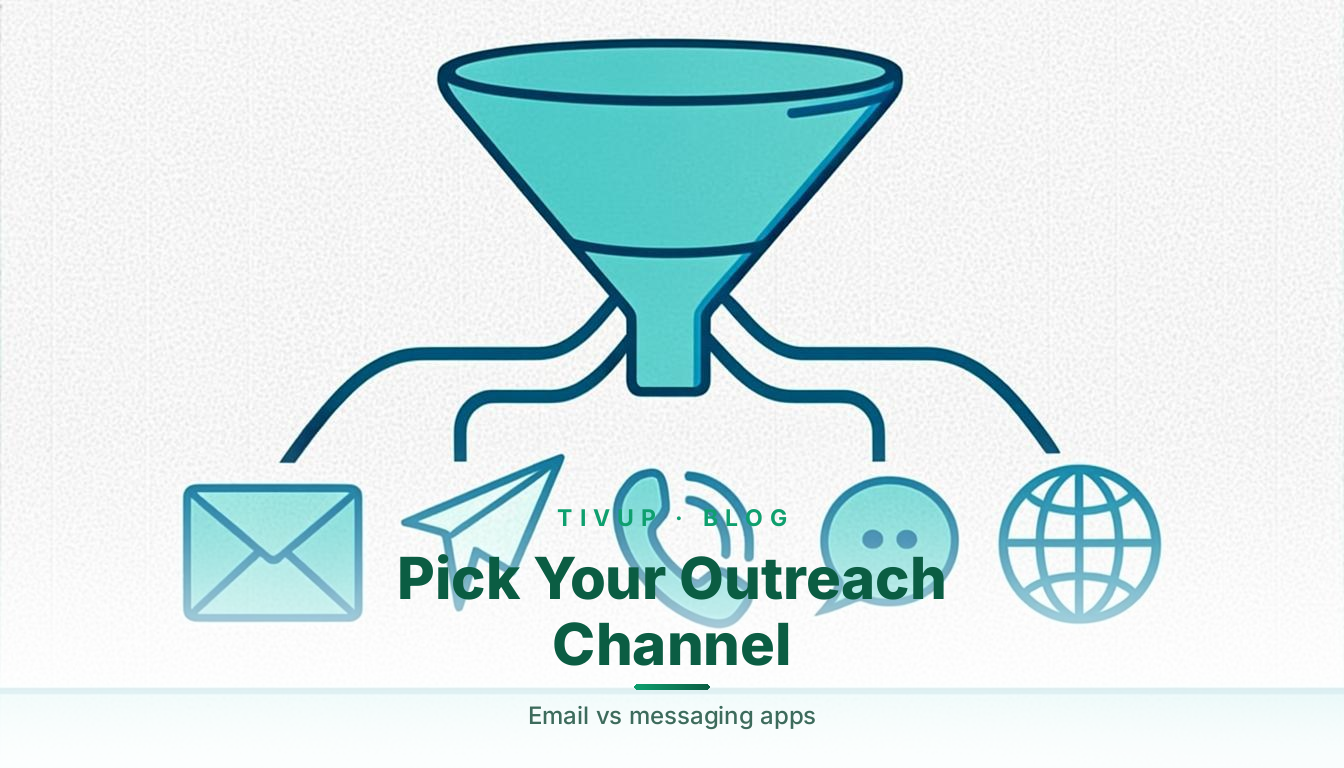
This guide compares the five outreach channels available in TivUp Pro campaigns — email, Telegram, SMS, WhatsApp, and additional regional messaging platforms — across what each is best for, what it costs in credits, the tone it supports, and its risk profile. Then we match channels to audience types, hand the routing decision to the multichannel scenario writer, and close with the compliance rules that keep every channel usable for the long run.
Why the Channel Is a Strategy Decision, Not a Detail
Treat channel selection as an administrative afterthought and it will quietly cap your results. Four things change the moment you pick a channel:
- Perceived intent. An email signals a considered business approach; a messaging-app ping signals availability for a quick chat; an SMS signals urgency — and your words inherit that frame.
- Cost per contact. Under the tivup.pro tariffs, email and Telegram messages cost 1 credit each while SMS and WhatsApp cost 2 — so the same list costs twice as much to reach on the pricier channels.
- Response rhythm. Email replies arrive over hours or days and tolerate length; chat replies arrive within minutes and punish anything longer than a few lines.
- Legal exposure. Email and SMS sit under mature, actively enforced regulation in many markets; messaging platforms occupy a grayer zone defined by user tolerance and platform policy.
Getting the channel wrong does not merely underperform — it can burn a lead permanently, and enough wrong sends drag your sender reputation down with it.
The Five Channels at a Glance
Here is the central decision table. Read each row as a specialist tool, not as a rival for the same job:
| Channel | Best for | Cost per message | Tone it supports | Risk profile |
|---|---|---|---|---|
| Formal B2B outreach, first introductions, proposals and attachments, long follow-up threads | 1 credit | Professional, structured | Low with verified addresses, honest sender identity, and a working opt-out link | |
| Telegram | Fast follow-up, informal updates, audiences that treat messaging as their inbox | 1 credit | Brief, conversational | Low to medium; personal short messages age well, bulk broadcast-style sends can get accounts flagged |
| SMS | Reminders, event-day logistics, expiring offers — genuine urgency only | 2 credits | Ultra-short, direct | Highest expectations; the strictest consent and quiet-hours rules of the five |
| Conversational international outreach, two-way dialogue, warm consumer markets | 2 credits | Warm, personal | Medium; strongest when the contact can plausibly expect the conversation | |
| Additional regional messaging platforms | Markets where a specific regional platform is the dominant channel everyone checks | 2–5 credits, depending on the platform | Follows local norms | Varies by platform; research platform policy and local regulation before sending at scale |
These figures come from the live tivup.pro tariffs: email and Telegram campaigns cost 1 credit per message, SMS and WhatsApp cost 2 credits per message, and additional regional messaging platforms cost 2–5 credits per message depending on the platform. Message costs sit on top of the standard pipeline costs — a complete lead (discovery, storage, enrichment, and verification) typically runs about 4 credits, so 100 credits covers roughly 25 complete leads before any campaign is sent. New accounts start with 10 free welcome credits, credits never expire, and a first-purchase bonus is listed on the live pricing page.
Email: The B2B Workhorse
At 1 credit per message, email remains the default channel for business outreach, for reasons no messaging app has replaced:
- Formality that survives forwarding. A proposal or price-list attachment travels inside an email without losing context — and can be forwarded to a colleague who was never on your list.
- Threading and archives. A decision-maker can find your message again three weeks later; a chat bubble scrolls away within an afternoon.
- A mature compliance path. A working opt-out link in every message is the accepted standard — and a legal requirement under regimes such as GDPR in Europe and CAN-SPAM in the United States.
Email’s weakness is the queue it lands in. Two habits protect performance: verify every address before sending — 1 credit per verification is far cheaper than the deliverability damage of a bounce — and plan a sequence rather than a blast, with one or two considerate follow-ups judged over days rather than over the first 24 hours.
Telegram: Speed at the Same One-Credit Price
Telegram shares email’s 1-credit price tag but behaves completely differently: messages in messaging apps tend to be seen within minutes rather than hours, and the register is conversational by default. That makes it the natural channel for:
- Fast follow-up — a short “I sent the details to your email this morning, happy to answer questions” nudge after a formal send.
- Audiences who live there — segments and markets that treat a messaging app as their primary inbox, where email quietly goes unread.
- Short, friendly announcements — a new offer, a time-limited slot, a quick confirmation of an appointment.
The informality cuts both ways: a tone that would feel lazy in email feels natural in a chat, but a broadcast-style blast feels correspondingly more intrusive on a personal messaging app. Keep Telegram messages short, personal, and answerable in one line.
SMS: Reserve It for Genuine Urgency
SMS is the priciest standard channel at 2 credits per message, and the format itself argues against casual use: a handful of characters, no attachments, at most one link. That is not a weakness when the message is genuinely urgent — it is the point. SMS earns its price tag when minutes matter:
- Appointment and delivery reminders — “Your supplier meeting is confirmed for tomorrow at 10:00.”
- Event-day logistics — a gate change, a start time, a last-minute instruction.
- Expiring windows — a trial slot that closes tonight, a quote valid until Friday.
What SMS should almost never be is a cold introduction. Of the five channels it faces the strictest consent expectations and quiet-hours rules in many jurisdictions, and an unsolicited promotional SMS at the wrong hour damages trust faster than any other message type. Treat the 2-credit price as the discipline that keeps the channel reserved for high-intent moments.
WhatsApp and Regional Platforms: Conversational Territory
WhatsApp, also at 2 credits per message, is the conversational default in many international consumer markets: two-way dialogue, quick replies, and a tolerance for media that email never had. It performs best when the contact can plausibly expect the conversation — a lead who filled in a form, replied to a campaign, or runs a business whose customers chat first.
Beyond the global platforms, additional regional messaging platforms cost 2–5 credits per message depending on the platform. They matter in markets where a local messenger is the channel everyone actually checks — sometimes the only channel they check. Because the tariff varies by platform, confirm the live cost in the panel before building a campaign around one, and check local messaging regulations before sending at scale.
Matching the Channel to the Audience
Channel choice is really audience choice: a B2B decision-maker and a local consumer not only prefer different channels, they read the same channel differently.
| Audience type | Start with | Escalate to | Keep the tone |
|---|---|---|---|
| B2B decision-maker (manager, procurement, director) | Verified email with the offer attached or clearly structured | A short messaging follow-up once a thread exists | Professional, specific, respectful of their calendar |
| Local business owner or sole proprietor | Email or messaging app — many respond faster in chat | A call or a visit, not more messages | Practical, brief, benefit-first |
| Consumer — considered purchase (courses, services, renovations) | Email or messaging with full details and a link | A gentle reminder two to three days later | Warm, informative, zero pressure |
| Consumer — impulse or local (events, offers, food) | A messaging app with a short invite | SMS (2 credits) only when time genuinely matters | Friendly, urgent but honest |
One pattern is worth internalizing: the higher the stake and the longer the cycle, the more the conversation belongs in email; the faster the expected decision, the more it belongs in a chat.
Smart Routing: Let the Scenario Writer Choose Per Lead
Everything so far has treated channel choice as a per-campaign decision. The sixth stage of the TivUp Pro Quick Process goes further: the multichannel scenario writer composes the outreach plan per lead, and channel selection is part of that scenario.
In practice, one run can produce a formal email sequence for a lead whose verified professional email points to a corporate environment, a short messaging script for a lead that exists only on a messaging platform, and an SMS variant for the time-sensitive segment — the routing follows the data each lead actually has, instead of forcing one channel onto the entire list.
Two safeguards keep this practical rather than reckless:
- Cost awareness. The cheaper channels carry the load by default — email and Telegram at 1 credit — with SMS, WhatsApp, and regional platforms (2–5 credits) reserved for the leads that justify them.
- Transparency. Pipeline Lab exposes the scenario decisions and the real cost of every node, so the routing is auditable after the fact rather than a black box.
If you are new to agentic lead generation, the tivup.me/pro page walks through how one input form becomes a routed, ready-to-send campaign.
Compliance: Opt-Outs, Quiet Hours, and the Law
Every channel gives the recipient a way to say no, and honoring it quickly is what keeps the channel alive for your next campaign:
- Email: a working unsubscribe link in every message, a truthful sender identity, and prompt removal — the core of CAN-SPAM in the United States and a central plank of GDPR in Europe.
- SMS and WhatsApp: a reply-based opt-out that is actually processed, real attention to consent, and strict quiet hours — many jurisdictions restrict messaging to business hours.
- Messaging platforms: an immediate stop on request, and a bias toward leads who had some plausible reason to hear from you.
Two habits cover most of the remaining risk: keep records of where each lead came from, and when in doubt choose the softer channel. A cold email is recoverable; a cold SMS at midnight is not.
A Five-Minute Decision Checklist
Before your next campaign, run the list through these questions:
- Classify each segment — B2B decision-maker, local business, or consumer — before writing a word of copy.
- Match the channel to the message’s job: introduction, follow-up, or urgency.
- Check the per-message credit cost of your channel mix before committing (email and Telegram 1; SMS and WhatsApp 2; regional platforms 2–5).
- Verify email addresses before every send — 1 credit per verification is cheaper than a bounce.
- Include a working opt-out on every channel, and process it immediately.
- Respect quiet hours and the local regulations of every market you message.
- Start with the 1-credit channels; move a lead to the 2-credit channels only when intent justifies it.
Conclusion
Channel selection is not the last step of campaign setup — it is part of the message itself. Email carries formality and attachments at 1 credit; Telegram carries speed and informality at the same price; SMS carries urgency at 2; WhatsApp and the regional platforms carry conversation at 2–5. The right choice depends on who the lead is, how fast they decide, and what the moment demands — precisely the judgment a scenario writer can make per lead, transparently and at a cost you can audit. Choose deliberately, comply visibly, and let each channel do the one job it does best.
TivUp Pro Routes Every Message
Run multichannel campaigns where the scenario writer picks the channel per lead — with per-message costs shown before you send, pay-per-success billing, and 10 free welcome credits when you sign up.