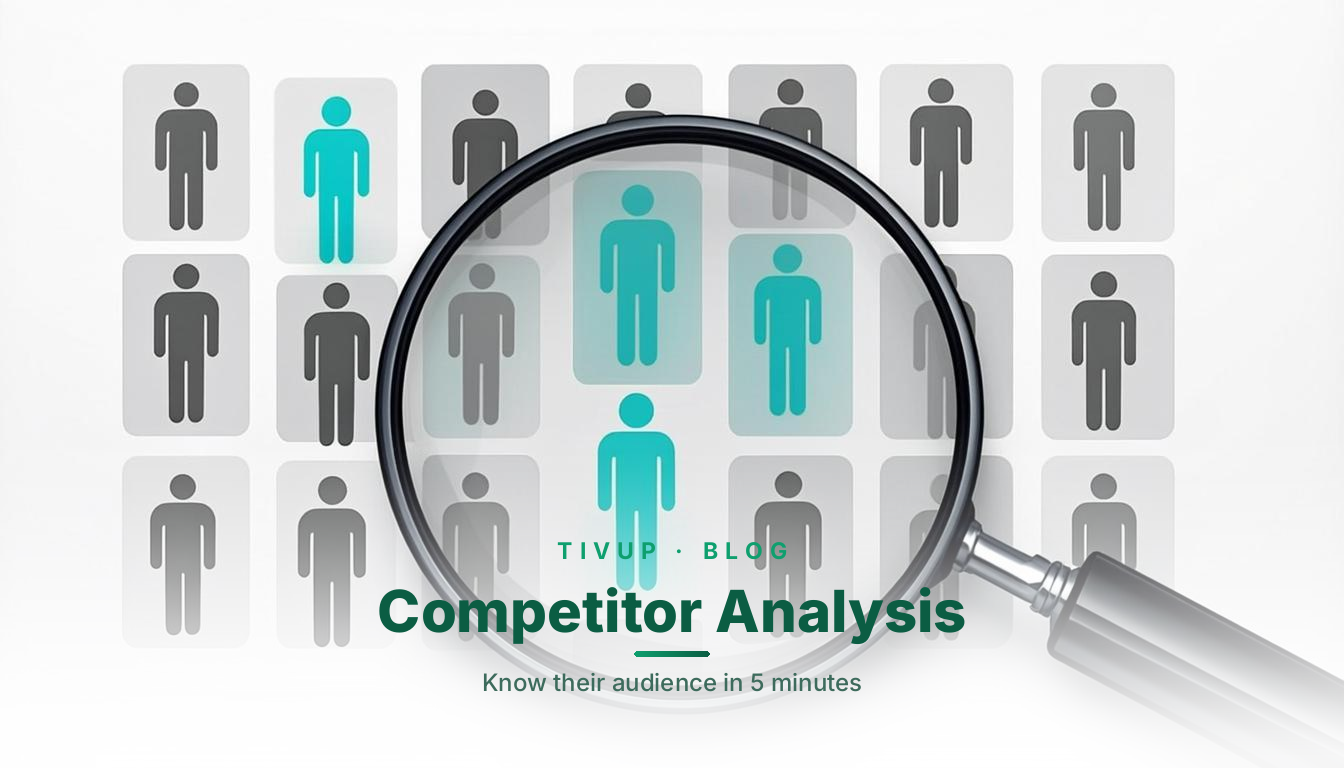

Your competitors have already done one of the hardest jobs in marketing: they built an audience from zero. Every follower on their public page is a person who looked at the same market you serve — the same pains, the same category, often the same vocabulary — and decided to raise a small hand. That is why a competitor’s follower list is less like a trophy cabinet and more like a public map of demand.
Competitor follower analysis means learning to read that map: who the competitor actually attracts (roles, industries, geographies), how that audience behaves, and — often the most valuable part — which segments they quietly fail to attract. It is not about poaching anyone’s customers. It is about understanding the shape of the market before you spend your own budget on campaigns.
This article walks through what follower data can and cannot tell you, how an automated pipeline turns public follower pages into a scored, enriched list measured against your ideal-customer profile, what each step costs in credits, and — because this technique touches real people — where the ethical and legal lines sit.
What a competitor’s followers can actually tell you
Reading a follower base is not about counting; it is about composition and gaps. Five signals carry most of the value:
| Signal | What it tells you | How you act on it |
|---|---|---|
| Follower composition — roles and seniority | Which professionals the competitor’s message actually resonates with | Sharpen your own ideal-customer profile; a mismatch between their audience and your pitch is a message problem before it is a list problem |
| Industries and company types | The segments where the competitor is strongest | Decide where to compete head-on and where your differentiation travels better |
| Geographies | Where demand for the category already exists | Sequence your market entry and localize channel choices |
| Engagement patterns | Which content and formats the audience responds to | Mirror the formats that work — with your own positioning on top |
| Gaps — segments visibly missing | Audience the competitor attracts poorly | Position a message for the ignored segment; it is often the least contested path in |
One honest caveat: follower lists are noisy. People follow business pages for many reasons — job hunting, general curiosity, a single useful post — so treat composition as directional evidence about a market, not a census of it. The scoring stage exists precisely to filter that noise.
From public pages to a scored list: the mechanics
Under the hood, competitor follower analysis is not a special hack — it is a disciplined lead-generation pipeline pointed at a specific public source. The competitor’s public follower pages become the discovery input, and everything after that is the same quality machinery any serious run deserves:
- Discovery: parallel discovery tools read the competitor’s public follower pages, alongside public directories, maps, and business networks for context. Each tool call costs 1–3 credits, depending on the tool.
- Aggregation and entity matching: raw records from several tools merge into one set, and entity-matching dedupe collapses duplicates — the same person appearing on two sources becomes one record, and one cost.
- Enrichment and verification: each surviving lead is completed with real contact data (2 credits per lead), and emails are verified (1 credit per verification) before anything is sent.
- Scoring against your profile: every lead is scored against your ideal-customer definition — industry, role, company size, geography — so the output arrives ranked by fit, not merely collected.
Notice what the output becomes: not “a list of their followers,” but “the subset of their followers that matches your ideal-customer profile, with verified contact data.” Same source; completely different value — and a much shorter path to a relevant first message.
The five-minute workflow
Five minutes is your part of the work — the setup. The pipeline then runs while you do something else. Here is the whole workflow, step by step, with its per-step credit costs:
| Step | Your action | Output | Approx. credits |
|---|---|---|---|
| 1. Define | Describe the competitor’s public page and your ideal-customer profile in the guided form | A configured run | No credits |
| 2. Plan | The smart brain turns your answers into precise search queries | A query set | 1 credit per brain call |
| 3. Discover | Parallel tools read the public follower pages and related public sources | Raw candidate records | 1–3 credits per tool call |
| 4. Store and dedupe | Aggregation and entity matching collapse the overlaps | One clean record per entity | 1 credit per stored lead |
| 5. Enrich | Each lead is completed with contact data | Enriched leads | 2 credits per lead |
| 6. Verify | Emails are checked before any sending | Deliverable contact data | 1 credit per verification |
| 7. Review | Open the ranked, scored list | Your outreach shortlist | No credits |
The economics follow the platform’s standard rule of thumb: a complete lead — discovered, stored, enriched, verified — costs about 4 credits, so 100 credits ≈ 25 complete leads. A first raw look at a competitor’s audience (discovery and storage only, without enrichment) costs a fraction of that, and the 10 free welcome credits are enough to see the first records appear before you spend anything. Credits never expire, so any leftovers simply wait for your next run, and credit-pack prices are always visible on the pricing page.
Where the ethical lines sit
This technique is powerful precisely because the data is public — and that is also why it deserves a clear rulebook. Public is not the same as permitted:
The compliance rulebook
- Public data is not consent. A person following a competitor’s public page has not agreed to hear from you. Visibility explains why a record exists; it does not by itself license a message.
- Know which law governs your outreach. In Europe, GDPR demands a lawful basis and respect for data-subject rights; in the United States, CAN-SPAM requires truthful headers and a working opt-out. Many other jurisdictions have their own regimes — the honest rule is to check before the first send, not after the first complaint.
- Platform terms of service are a gray zone. Automated collection of follower data sits somewhere between tolerated and prohibited on many platforms. Where an official API exists, prefer it — it is the route the platform built for exactly this kind of access.
- Treat the output as research first. Follower analysis is at its best as market intelligence. If it becomes outreach, that outreach must clear the same bar as any campaign: relevance, honesty, and a clear way out.
A practical summary: use the follower map to understand the market and to build a targeted, verified list — and let the legitimacy of each message rest on your compliance with the rules that govern it, never on the mere visibility of the data it started from.
How Quick Process runs it — and shows its work
In TivUp Pro, competitor follower analysis is not a bolted-on feature; it is a configured run of the Quick Process — the platform’s six-stage pipeline: a guided input form, the smart brain that plans queries, parallel discovery across multiple search and scraping tools, aggregation with scoring and entity-matching dedupe, enrichment with email verification, and a multichannel scenario writer that prepares the outreach itself.
Two things make the run audit-friendly rather than a black box:
- The estimate before the run. The panel shows the full credit math before you press start — the fixed smart-brain calls, the per-tool call estimates, the per-lead storage and enrichment, the total, and the balance you will have left afterwards.
- Pipeline Lab after the run. The transparency view shows exactly what every credit did: every tool call, every stored lead, every enrichment, every verification, every score.
If credits run short mid-run, the pipeline stops with a clear error and the decision stays yours — no hidden charges. And if you want to see the six-step form before you open an account, a short visual walkthrough lives on the transitional page.
A sanity checklist before your first run
Six checks, five minutes, zero regrets — run through them before any competitor-audience campaign:
- ✓ Is the data source genuinely public, and is my collection method one I can defend?
- ✓ Does my ideal-customer profile have concrete criteria — industry, role, size, geography — so the scoring means something?
- ✓ Will emails be verified before the first message goes out?
- ✓ Have I checked which privacy regime — GDPR, CAN-SPAM, or local law — applies to my recipients?
- ✓ Where an official API exists for the platform I am researching, am I preferring it?
- ✓ Is my first message relevant, honest, and easy to opt out of?
Six green ticks, and you are not just “doing competitor analysis” — you are doing it in a way that survives a compliance question in a quarterly review.
Conclusion: a map, not a mailing list
At its best, competitor follower analysis is market research at the speed of automation: read who the market already listens to, score that audience against your own definition of a good customer, enrich and verify only the part that matters, and treat the rest as intelligence rather than inventory.
The competitor built the audience. The public data draws the map. The pipeline turns the map into a ranked, verified shortlist — minutes of your setup, a cost you approved in advance, and a ledger that shows where every credit went.
Turn a competitor’s audience into your shortlist
Open the panel, describe the competitor’s public page and your ideal customer in the guided form, and let the Quick Process score their audience against your profile — 10 welcome credits included, no card required.