
Somewhere on your hard drive — or more likely in a shared spreadsheet — there is probably a list of promising companies. It may have come from a trade directory, an industry event, a quick round of web searches, or a scroll through social platforms. It has names. What it usually does not have is a working email address, a phone number that a human actually answers, or any idea who the decision-maker is. And a lead you cannot reach is, for all practical sales purposes, just a row in a spreadsheet.
That gap between knowing a company exists and being able to start a conversation with it is exactly what lead enrichment closes. This guide takes the concept apart piece by piece: what enrichment adds to a raw lead, where the data actually comes from, how email verification works under the hood, why an unverified list can quietly wreck your sender reputation, and what every step costs under the TivUp Pro credit system — where enrichment is 2 credits per lead and email verification is 1 credit per check, so you only pay for the leads you actually run.
What Is Lead Enrichment?
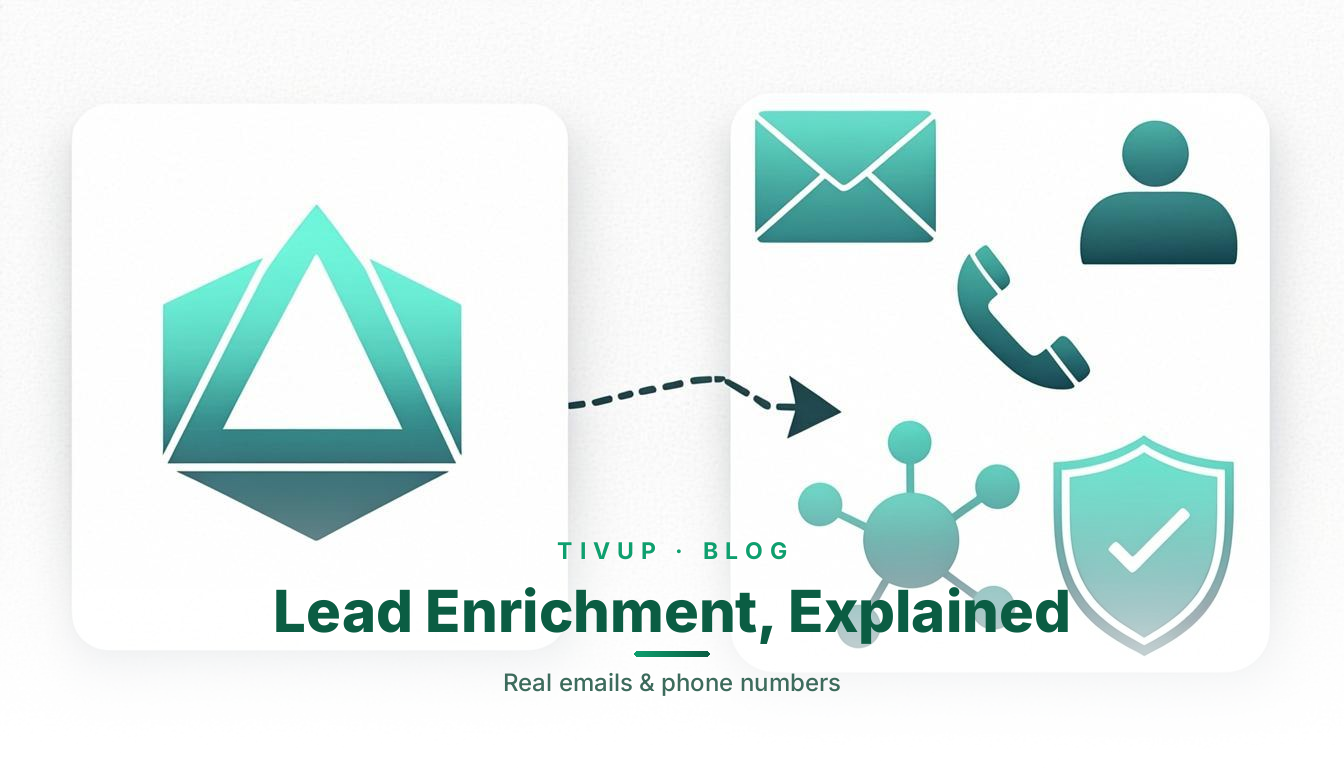
Lead enrichment is the process of taking a bare lead — a company name, a social handle, a fragment of an address — and attaching the missing details that make real outreach possible: a verified email address, a direct phone number, the name and role of a relevant contact, social profiles, and basic company data such as the website.
The easiest way to see the value is to compare the same lead before and after enrichment:
| Field | Raw lead | Enriched lead |
|---|---|---|
| Company name | Present | Present, cleaned and standardized |
| Website | Sometimes present | Present |
| Email address | Missing, or a generic address that may not work | A specific address, verified before sending |
| Phone number | Missing | Present |
| Contact person and role | Unknown | Known |
| Social profiles | Maybe one, found by accident | Collected and linked to the lead |
| Campaign readiness | Not ready to contact | Ready for a verified outreach sequence |
The difference is not cosmetic. A raw lead forces your campaign to guess — generic greetings, generic value pitches, send-and-pray delivery. An enriched lead lets you aim: a named person, a role, a channel that works, and a message that can reference something true about the business.
What Enrichment Adds to a Lead
Depending on your outreach channel, different fields carry different weight. Here is the typical package an enrichment pass adds, and why each piece earns its place:
| Data point | What it gives you | Why it matters for outreach |
|---|---|---|
| Email address | The primary B2B outreach channel | The field you will verify before every send — the backbone of cold outreach |
| Phone number | A synchronous, high-attention channel | Worth its cost for high-value leads where a call shortens the sales cycle |
| Contact person and role | A human to talk to | Lets you write to a decision-maker instead of a faceless mailbox |
| Social profiles | Context and a second touchpoint | You can see what the business publishes before you write a word |
| Company details | A qualification signal | Website and size clues help you sort the fits from the non-fits before spending credits |
Notice that enrichment is not only about contact details. The role and company data are what make personalization honest — you can mention something specific because you actually know something specific.
Where Enriched Data Comes From
Enrichment does not conjure data out of thin air. It collects it from places where businesses have already published it — and the quality of an enriched lead depends heavily on how many sources get checked:
- The public web: company websites, contact pages, about pages, and pages that mention the business — harvested through search-engine result scraping and intelligent page reading.
- Business directories: curated listings that already carry categories, addresses, and sometimes public contact fields.
- Social platforms: public business pages, bios, and contact buttons — for example the data surfaced by Instagram discovery tools.
- Professional networks: the natural home of role, title, and company information for B2B contacts.
- Specialized enrichment services that cross-reference these public traces into a single, deduplicated profile.
Two honest caveats. First: public is not the same as permitted. A business publishing its email address is not the same as that business consenting to receive marketing — build your outreach on a defensible basis and always include a working opt-out. Second: contact data decays. Companies switch email providers, people change roles, domains expire. An enriched lead is a snapshot, not a permanent truth — which is exactly why the verification step exists.
Why Unverified Lists Destroy Sender Reputation
To understand why verification matters so much, you need to understand how mailbox providers think. Every large email provider — the ones hosting most of your prospects’ inboxes — tracks the behavior of senders. How many messages bounce. How many get marked as spam. How many are opened, and how many are answered without complaint.
Send to a clean, verified list and your sending domain builds a quiet record of competence. Send to a stale, unverified one and a meaningful share of your messages bounce back — and bounced messages are treated as the sender’s fault, because they are. The consequences arrive in stages: first deliverability dips, then messages start landing in the spam folder instead of the inbox, and eventually providers may refuse your mail outright. Reputation is slow to build and remarkably quick to lose — and a single reckless campaign against a decayed list can undo months of careful sending.
Verification is the insurance policy against all of that. In TivUp Pro it costs 1 credit per email — a small price next to what a damaged sender domain costs you in missed replies for weeks or months afterwards. That is why the enrichment stage of the pipeline verifies every email before a single campaign message is sent.
How Email Verification Works: Three Levels of Proof
Email verification is not a single check but a stack of them, each deeper than the last. A serious verification process runs all three:
| Check level | What it examines | What it catches |
|---|---|---|
| 1. Syntax check | Whether the string is a well-formed email address at all | Typos, malformed strings, obvious placeholder text |
| 2. Domain and MX check | Whether the address’s domain actually accepts mail | Dead domains, expired websites, domains with no mail server configured |
| 3. Mailbox-level check | Whether the specific mailbox exists and can receive messages (an SMTP-level conversation) | Closed accounts and abandoned inboxes; flags risky catch-all domains for extra caution |
A syntax check alone will happily bless an address that has never existed. Only the mailbox-level check confirms that a real inbox sits on the other side — which is why it is the step that actually protects your sender reputation. In TivUp Pro, every email discovered during enrichment goes through this verification stack before your campaign is allowed to send to it.
Enrichment Inside the Quick Process
In TivUp Pro, enrichment is the fifth stage of the Quick Process — the guided pipeline that runs from a short input form, through a smart brain that builds the search queries, parallel discovery across multiple search and scraping tools, aggregation with scoring and entity-matching deduplication, and finally enrichment with email verification, before the multichannel scenario writer drafts your outreach. If you want to see how the Quick Process works stage by stage, the walkthrough page maps every step.
The position in the chain matters. Because enrichment happens after deduplication, you never pay twice for the same business — a company that arrives from two different sources is matched into one entity first. And because verification happens inside the same stage, the list that reaches your campaign is already clean. For those who want to look under the hood, Pipeline Lab shows every node of every run — the prompts, the tools, and the exact credit cost of each step — so enrichment is never a black box.
What Enrichment Costs in TivUp Credits
TivUp Pro prices enrichment the same way it prices everything else: pay-as-you-go, per operation, with the exact cost visible before you run anything. The relevant tariffs:
| Operation | Tariff |
|---|---|
| Discovery tool call | 1–3 credits per call, depending on the tool |
| Each stored lead | 1 credit |
| Enrichment | 2 credits per lead |
| Email verification | 1 credit per verification |
Put those numbers on a concrete example — the same 25-lead batch used in earlier posts on this blog. Enrichment costs 25 × 2 = 50 credits, and verification adds another 25 × 1 = 25 credits. On top of a raw discovery run, which lands at roughly 31–35 credits for that batch, a fully enriched run comes to about 106–110 credits. In other words, roughly 4 credits per complete lead: discovered, stored, enriched, and verified. That is the arithmetic behind the rule of thumb on the pricing page: 100 credits ≈ 25 complete leads.
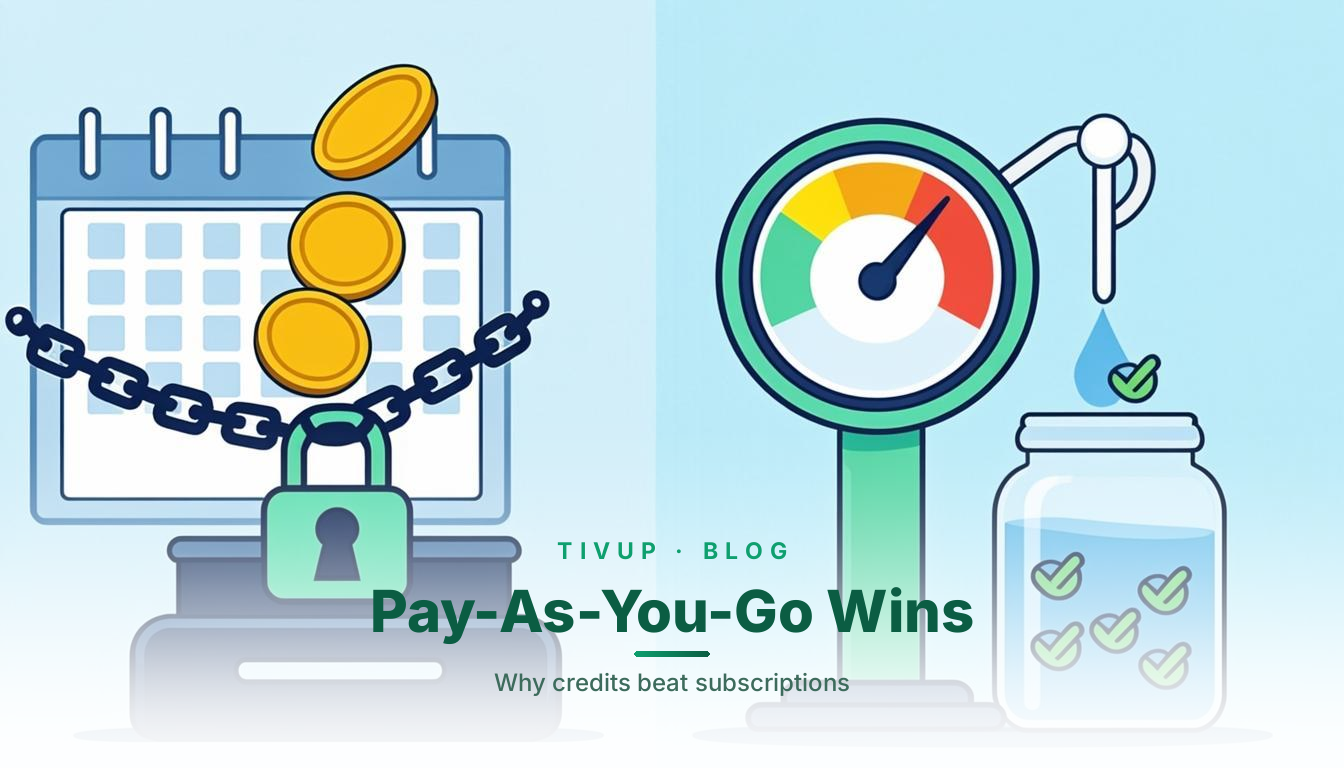
The fine print of the model is friendly. You pay only for the leads you actually run — enrichment is optional, and if your channel does not need email you can skip it, though for email outreach it is effectively mandatory. Unsuccessful tool calls cost zero credits, under the pay-per-success philosophy. Credits never expire, so an unused balance is never wasted. New accounts start with 10 free welcome credits — enough to test discovery and enrichment on a small batch before paying anything — and a first-purchase bonus is available; see the live pricing page for current details.
Checklist: Before You Enrich Your Next List
Whether you enrich inside TivUp Pro or anywhere else, run through this list before spending a single credit:
- Deduplicate first — enriching the same business twice is pure waste; entity matching should happen before enrichment.
- Decide which channels you will actually use before enriching — a phone number you will never call has a price and no value.
- Verify every email inside the same cycle as your campaign — a list verified months ago is a list that has decayed since.
- Watch bounces after every send and suppress hard-bounced addresses immediately.
- Keep the source of every lead — you may need to explain your legitimate interest later.
- Re-verify before large campaigns; verification credits are the cheapest protection your sender reputation will ever buy.
Conclusion
Lead enrichment is the bridge between a list of names and a list of people you can actually talk to. It pulls emails, phone numbers, roles, and company details from the public web, business directories, social platforms, and professional networks; it costs 2 credits per lead in TivUp Pro with verification at 1 credit per email; and its most important rule is simple: verify before you send, because sender reputation is the asset every future campaign depends on.
The leads are out there, published and waiting to be found. The question is whether they arrive on your desk enriched and verified — or as rows in a spreadsheet.
Turn Raw Rows into Reachable Contacts
TivUp Pro enriches your discovered leads with real emails and phone numbers — and verifies every address before a single message is sent. Pay only for the leads you run, starting with 10 free welcome credits.
Read next
- Smart Lead Generation Pipeline: The 6-Stage Map — The full pipeline enrichment powers.
- 13 Ways to Extract Leads from Instagram — The discovery side of the data.
- 6 Lead Generation Mistakes That Kill Results — Why enriched leads outperform raw contacts.