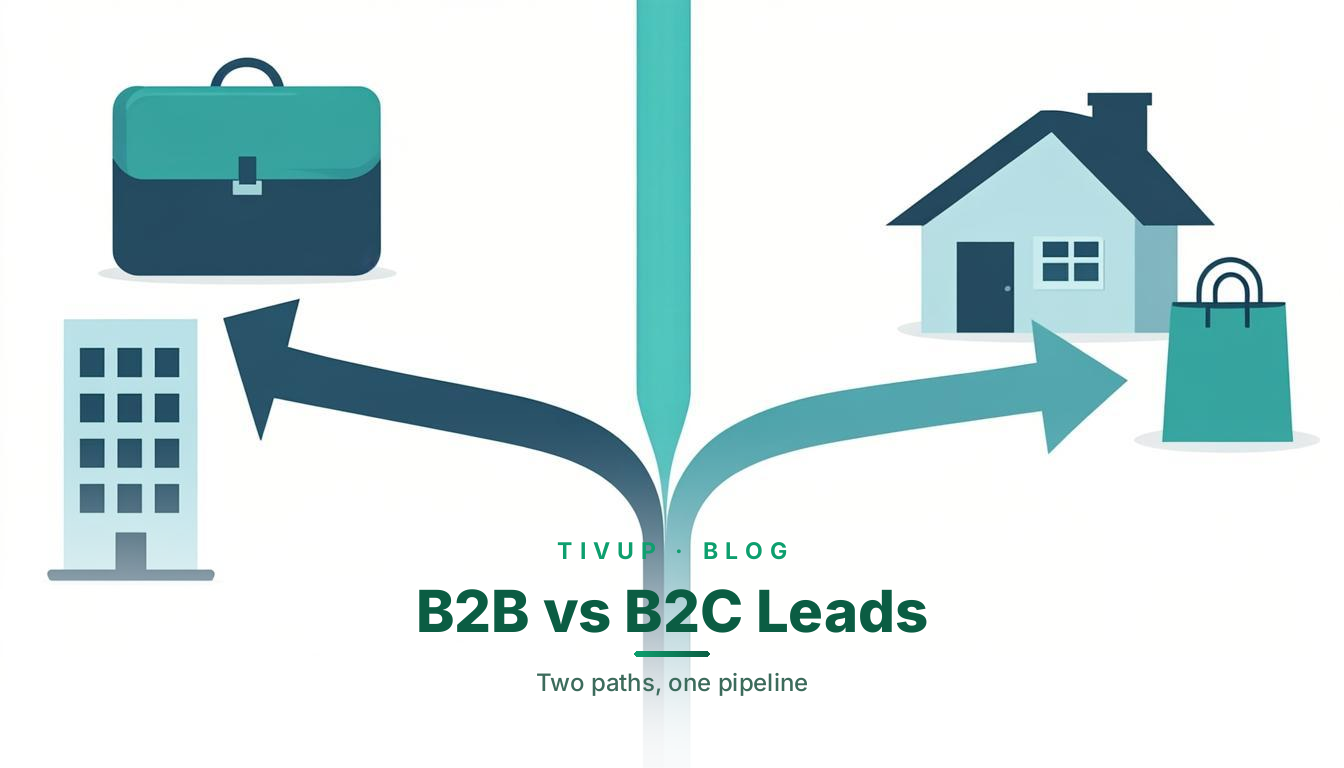

On the same day, in the same city, two very different purchases begin. A procurement manager at a mid-size manufacturer starts looking for a new packaging supplier — a decision that will take weeks, involve several people, and end in a contract. A local resident decides on a whim to try the new fitness studio down the street — a decision that will take one evening, involve one person, and end in a monthly membership.
Both of them are leads. But they are not the same lead, and the path that converts one will bore or irritate the other. Run a B2B playbook on a consumer list and your formal, attachment-heavy emails sit unopened in inboxes that rarely open them. Run a B2C playbook on a business list and your chatty messaging blasts read as unprofessional by the second sentence.
In this guide we compare the two lead types side by side — profile, query patterns, channels, tone, cycle length, and cost per contact in TivUp credits — then walk through a worked example of each, and show how the same six-stage pipeline serves both with nothing more than different configurations.
Two Buyers, Two Games
The difference starts with how the decision gets made:
- B2B decisions are committee decisions. The person who finds you is rarely the person who signs. A champion surfaces the need, a manager evaluates, finance approves — and the deal dies quietly if any of them is not convinced.
- B2C decisions are personal decisions. One person feels the need, weighs it against the price, and decides — often the same day, moved by convenience and emotion as much as by features.
Everything else follows from that fork. B2B lead generation optimizes for depth: the right role inside the right company, contacted formally, nurtured patiently, because each converted lead is worth a large multiple of the effort spent on it. B2C optimizes for volume and speed: find many people with the right interest, reach them where they already chat, and make saying yes easy, because the window of intent closes fast.
The Side-by-Side Comparison
Here is the whole difference in one table:
| Dimension | B2B leads | B2C leads |
|---|---|---|
| Lead profile | Role-holders inside companies: managers, procurement, operations, founders | Individual consumers identified by interest, life stage, and location |
| Typical query patterns | Role- and company-based: “Sales Manager,” “procurement,” industry and company-size filters | Interest- and demographic-based: hobbies, life events, neighborhoods, local communities |
| Best channels | Email-first with LinkedIn-style professional touches; formal follow-up sequences | Messaging-app-first; email for details; SMS only for time-sensitive offers |
| Message tone | Professional, specific, value-and-ROI oriented | Warm, emotional, benefit-first, easy to answer |
| Cycle length | Weeks to months, multiple stakeholders, several touchpoints | Hours to days, single decision-maker, few touchpoints |
| Cost per contact in TivUp credits | Deep path: 1–3 per discovery call, 1 per stored lead, 2 per enrichment, 1 per verification — about 4 credits per complete lead | Lean path: 1-credit discovery calls, 1 per stored lead, 1-credit messaging sends; enrichment only when a contact is missing |
The tariffs are identical for both worlds — 1 credit per smart-brain LLM call, 1–3 per discovery tool call, 1 per stored lead, 2 per enrichment, 1 per email verification, and 1–5 per campaign message depending on the channel. What differs is how much of the pipeline each lead justifies. A complete lead (discovery, storage, enrichment, verification) runs about 4 credits, so 100 credits covers roughly 25 complete leads — a sensible planning figure for B2B. High-volume B2C runs usually lean on the 1-credit discovery and messaging channels and skip enrichment where a direct contact already exists. Credits never expire, every account starts with 10 free welcome credits, and a first-purchase bonus is listed on the pricing page.
The B2B Path: Roles, Committees, and Patience
B2B discovery starts from role-based queries. Instead of searching for “people who might buy office supplies,” you search for the job titles that own the problem — “Sales Manager,” “procurement,” “office administrator,” “operations manager” — filtered by the industries and company types that fit your offer. The result is a small list where every contact is relevant by the definition of their job.
Outreach follows the same logic: email-first, with LinkedIn-style professional touches where the platform fits your market. A formal introduction with a concrete, role-specific reason for writing; an attachment the recipient can forward internally; two patient follow-ups spaced days apart. Pushing for a close in the first message is the classic B2B error — the buyer’s job is to compare options and de-risk the purchase, and the message that respects that process is the one that survives it.
Patience pays because the value per lead is high. A single won supply contract can justify the full investment in a list of a few dozen contacts. That is why B2B runs usually take the complete path: discovery, enrichment at 2 credits per lead, and verification at 1 credit per email, so that every message lands on a real, reachable decision-maker rather than on a role-shaped guess.
The B2C Path: Impulse, Emotion, Volume
Consumers are found through interest and demographic queries: the hobby, the life stage, the neighborhood, the community. “Yoga beginners,” “new parents,” “weekend runners,” “recent movers” — patterns that describe people whose current situation makes them receptive, rather than their job title.
Outreach is messaging-app-first, because chats match the speed of the decision. Short, warm, benefit-forward messages go out on the 1-credit channels; email is reserved for the details — schedule, pricing, terms — and SMS at 2 credits is saved for genuinely time-sensitive moments: a class starting tonight, a limited trial slot expiring, a same-day delivery window.
The tone is emotional in the honest sense of the word: lead with the felt benefit (“train in the evening without rearranging your whole day”), make the next step one tap away, and accept that part of any consumer list was never going to convert this week. Volume and freshness do the work that formality does in B2B.
Worked Example: The Office-Supplies Distributor (B2B)
A distributor of office supplies wants recurring contracts with mid-size companies in its region. The B2B configuration looks like this:
- Queries: role-based — office managers, procurement staff, and administrators, filtered to target industries and company sizes.
- Channels: verified email with a one-page offer attached, a follow-up a few days later, and a light messaging nudge only once a thread exists.
- Tone: formal, specific, numbers-forward — delivery terms, catalog, references from similar clients.
- Cycle: weeks. Success is measured in replies and meetings booked, not same-day sales.
The credit math is small-list, deep-path: discovery tool calls at 1–3 credits each plus 1 credit per stored lead; enrichment at 2 credits and verification at 1 credit per lead — roughly 4 credits per complete lead, so a 100-credit budget maps to about 25 complete, verified B2B contacts. If even one of those becomes a recurring account, the arithmetic has already paid for itself.
Worked Example: The Neighborhood Fitness Studio (B2C)
The same pipeline, opposite configuration. A fitness studio wants to fill its new evening classes:
- Queries: interest- and location-based — fitness and running communities, local audience discovery around the studio’s neighborhood.
- Channels: a short, warm invite on a 1-credit messaging channel; email only for the schedule and pricing; SMS at 2 credits for a day-before reminder once someone books a trial slot.
- Tone: friendly and concrete — the class time, the first-session offer, one-tap booking.
- Cycle: days. Success is measured in trial bookings this week.
Here the math is wide-list, lean-path: 1-credit discovery calls, 1 credit per stored lead, and messaging at 1 credit per send — skipping enrichment where the discovered contact already has a direct messaging route. You spend less per lead and make it up in volume and speed of follow-up, which is exactly what an impulse purchase rewards.
One Pipeline, Two Configurations
None of this requires two products. The Quick Process in TivUp Pro runs the same six stages for both lead types — what changes is the configuration at each stage:
| Pipeline stage | B2B configuration | B2C configuration |
|---|---|---|
| 1. Input form | Describe the target role and industry — procurement managers in food manufacturing | Describe the audience and interest — beginner runners in the studio’s neighborhood |
| 2. Smart brain (1 credit per call) | Plans role-based queries across business sources | Plans interest- and location-based queries across social and local sources |
| 3. Parallel discovery (1–3 credits per tool call) | Company websites, business directories, professional platforms | Social platforms, location pages, local communities |
| 4. Aggregation, scoring, entity-matching dedupe | Scores by role seniority and company fit | Scores by interest fit and proximity |
| 5. Enrichment and email verification (2 + 1 credits per lead) | Full path — verified professional emails for the whole list | Selective — only where no direct contact already exists |
| 6. Multichannel scenario writer | Formal email sequences with attachments, patient follow-ups | Warm short messaging scripts, SMS reserved for urgency |
Because Pipeline Lab exposes every run node by node — the prompts, the tools, the per-node costs — you can see exactly how the two configurations diverge and what each difference costs. And when a single list contains both kinds of lead, the scenario writer routes each one down the path its profile suggests, rather than forcing one channel and one tone onto everyone. If you want to see the full six-stage flow before running your first configuration, the tivup.me/pro page walks through it end to end.
Before You Build Your Next Path
Run your next lead-generation idea through this checklist:
- Write down who signs the decision (B2B) or what triggers the urge (B2C) before choosing any tool.
- Choose queries by role for B2B, by interest and location for B2C.
- Pick the channel mix before writing copy — email-first for committees, messaging-first for consumers.
- Set the right success metric: replies and meetings for B2B, bookings and sales for B2C.
- Budget credits per segment — about 4 credits per complete lead as the planning figure, less if you skip enrichment.
- Verify every email before it enters a sequence (1 credit per verification).
- Keep opt-outs working on every channel — consumers report unsolicited messages faster than procurement managers do.
Conclusion
B2B and B2C leads differ in profile, queries, channels, tone, cycle, and budgeting — but not in plumbing. One six-stage pipeline finds roles for the distributor and interests for the studio, enriches the first deeply and the second sparingly, and writes a formal email sequence for one and a warm chat script for the other. The craft is in the configuration; the engine is the same. Decide who you are really selling to, configure the path for that buyer, and let the pipeline do the rest.
Build Both Paths in TivUp Pro
Configure the Quick Process for B2B depth or B2C volume — with per-node costs exposed in Pipeline Lab, pay-per-success billing, and 10 free welcome credits when you create an account.