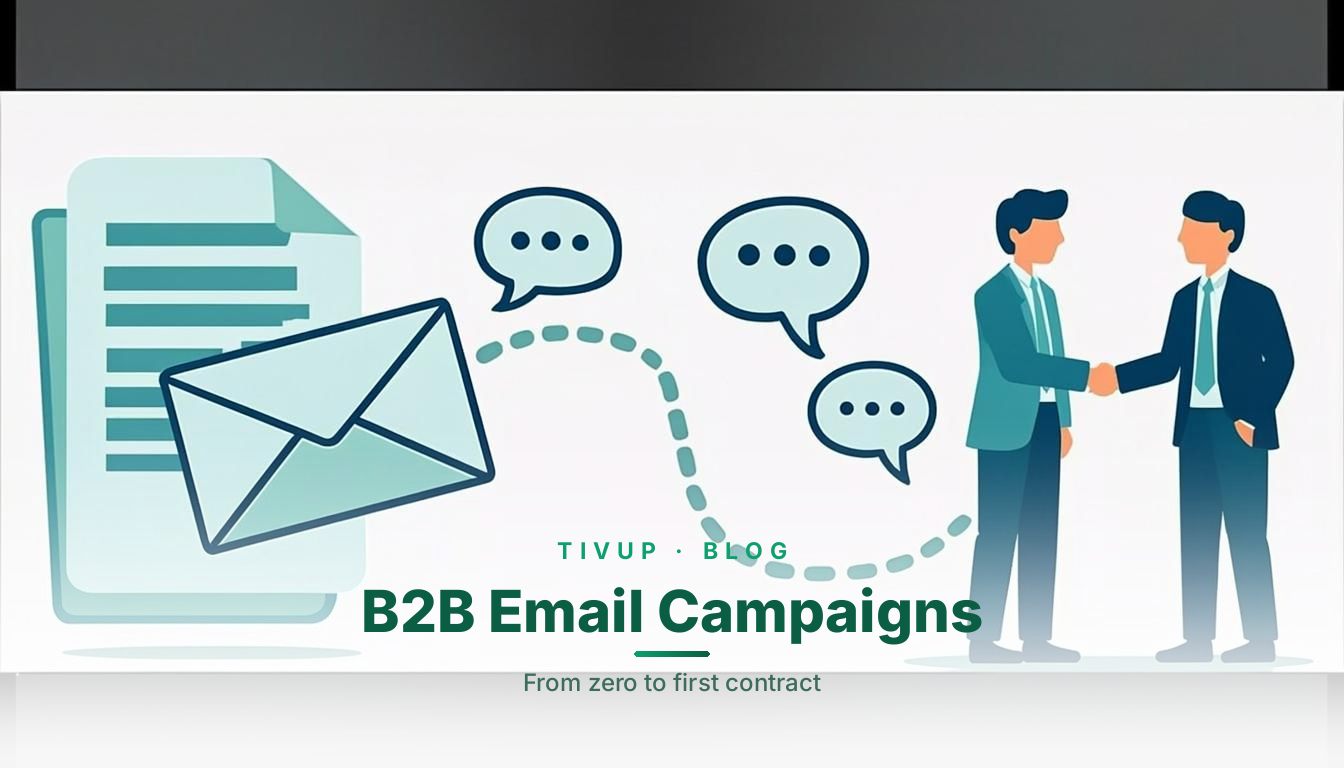

Email is not glamorous. No feed, no algorithm, no viral moments. Yet in B2B it remains the front door: a direct line to a decision-maker’s attention. Which raises the question every founder, freelancer, and small sales team eventually faces — how do you go from an empty contact list to a signed contract in the inbox?
This is a playbook, not a theory piece. Five steps: build a list you own, enrich and verify it, write a first message that earns a reply, follow up without pestering, and measure the only metric that pays — meetings that turn into contracts. Along the way: two message templates, a compliance shortlist, and the credit math for running the whole journey through TivUp Pro, where email and Telegram messages cost 1 credit each.
Step 1 — Build a List You Own
The shortcut that ruins most first campaigns is the purchased list. It looks like a head start; it behaves like a trap. Bought data is stale by the time it reaches you, has often been sold to other senders before you, and creates both bounces and legal exposure. Campaigns built on it burn sender reputation before they ever book a meeting.
The alternative is discovery — finding the businesses yourself, from sources where they published their own presence. The Quick Process in TivUp Pro does this in parallel: search-engine result scraping, business directories, social platforms, and Instagram discovery tools, all queried at once, with results aggregated, scored against your goal, and deduplicated through entity matching so one business equals one lead — not three rows from three sources. Discovery costs 1–3 credits per tool call, plus 1 credit per stored lead, and failed tools cost nothing.
A discovered list is smaller than a purchased one. It is also yours: fresh, traceable, and defensible when someone asks where your contacts came from.
Step 2 — Enrich and Verify Before You Write a Word
A discovered lead is still, usually, a name and a website. Enrichment attaches the reach: real email addresses, phone numbers, the contact’s name and role, and the company details that let you write like you know them. In TivUp Pro, enrichment costs 2 credits per lead.
Then comes the step that separates a campaign from a gamble: email verification, at 1 credit per check, running each address through syntax, domain, and mailbox-level controls before anything is sent. A campaign is only as strong as its worst address — every bounce dents your sending domain’s reputation, and enough of them quietly route your mail to the spam folder. Verification is the cheapest insurance in this playbook.
If you want to see how the Quick Process works — discovery, enrichment, verification, and campaign drafting as one connected chain — the walkthrough page maps every stage.
Step 3 — The First Message: Principles Before Templates
Templates are useful; principles make them work. Internalize the shape of a first message that gets answered:
- Short. A few sentences, readable on a phone screen without scrolling. Long enough to be specific, short enough to be finished.
- Personal where it counts. One line that proves you looked at their business specifically — not a swapped first-name token.
- One clear ask. A question, or a short call. One ask, not three — a single small ask is far easier to answer.
- A real human on the other side. A real sender name, a real company, a reply-to someone actually monitors.
- Nothing heavy. No attachments or image-heavy layout on a first touch — plain text survives spam filters and looks like a person writing to a person.
- An easy exit. A one-line opt-out in every message. It is compliance hygiene, and it lowers the cost of saying yes.
A First-Message Template That Earns Replies
Here is a template in that shape. Everything in brackets is where your research goes — the enriched data from the previous steps is what fills it honestly:
Subject: Question about [something specific to their business]
Hi [First name],
I came across [Company] while [one true sentence about how you found them — their listings, their work, their specialty]. [One short sentence about who you are and what you do.]
We help businesses like [Company] [one concrete outcome in plain language — no jargon, no superlatives].
Would a short call this week make sense? Fifteen minutes, and I will come with questions rather than a pitch.
If this is not relevant right now, a one-line “not for us” is a perfectly good answer.
[Your name]
[Your company] — [your website]
Why this shape works: the subject is a question about them, so it gets opened; the opening line proves specificity; the outcome is one sentence; the ask is small and single; and the closing line invites a cheap “no” — which paradoxically makes a “yes” more likely, and keeps disappointed readers away from the spam button.
Step 4 — The Follow-Up Cadence: Two or Three Touches
Here is the part most first-time senders get wrong: silence after the first message is the norm, not a verdict. Inboxes are crowded, and your note may simply have sunk. A polite follow-up is not pestering — it gives a busy person a second, easier chance to say yes or no.
The cadence that respects both sides: wait a few business days, then follow up once with something new. If that also goes unanswered, send one final, polite close — then stop, and move the lead to a long-term list for a later campaign. Two or three touches in total. More than that stops being persistence and starts being pressure.
Subject: Re: Question about [the same specific thing]
Hi [First name],
Following up on my note from last week — inboxes being what they are.
[One new sentence only: a detail you did not mention before — how a similar business used your service, a resource worth skimming, or a different angle on the same outcome.]
If the timing is simply wrong, tell me a better month and I will come back then. And if it is a no — that is a fine answer too.
[Your name]
Note what the follow-up never does: it never guilt-trips (“just checking in again”), never resends the identical pitch, and never pretends the first email did not happen. It adds one new piece of information and renews the easy exit.
Step 5 — Measure Meetings, Not Vanity Metrics
Opens and replies are diagnostics. Meetings booked and contracts signed are the goal. Confusing the two is how teams end up optimizing subject lines while the pipeline stays empty:
| Metric | What it actually tells you | What it cannot tell you |
|---|---|---|
| Open rate | Deliverability and subject-line quality | Whether anyone cared about the content |
| Reply rate | Whether the message resonated | Whether the replies are positive |
| Meetings booked | Real interest from real people | Whether the fit survives the call |
| Contracts signed | That the whole system works | — |
Read the chain: low opens point at deliverability or subject lines; opens without replies at the message; replies without meetings at your ask; meetings without contracts at what you sell or how you qualify. Each broken link has a different repair — none is fixed by sending more email.
The AI Scenario Writer: Your First Draft in Minutes
The honest wall of this playbook is effort. Writing dozens of genuinely personalized messages — first touches and follow-ups, matched to each role and channel — is hours of careful work, and it is where most campaigns quietly die. That is what the multichannel scenario writer in TivUp Pro solves: as the final stage of the Quick Process, it drafts the entire outreach sequence from your enriched lead list — first message, follow-ups, channel-appropriate tone — as a first draft you review instead of a blank page. You remain the campaign manager: every message is previewed before anything is sent, and your edits take precedence. The draft costs a single LLM call — 1 credit — no matter how many messages the sequence contains; and because it is multichannel, the same engine drafts the shorter, more casual messages for messaging channels. Pipeline Lab shows the full run node by node — what was drafted, sent, and spent.
Compliance: GDPR, CAN-SPAM, and Common Sense
Cold B2B email is legal in many markets — but the rules differ, and “it worked yesterday” is not a compliance strategy. Two frameworks worth knowing by name: GDPR in Europe and CAN-SPAM in the United States. Under GDPR, B2B outreach generally needs a defensible basis such as legitimate interest, an honest identity, and a working opt-out you honor quickly. CAN-SPAM demands accurate sender and subject information, a valid physical postal address, and prompt respect for opt-outs. Other markets have equivalents — check the rules you send into.
The good news: everything this playbook has already told you to do — build your own list, verify it, identify yourself, keep one honest ask, offer an easy exit — is also the compliance path. The behavior that gets senders into trouble is the same behavior that produces bounces: stale purchased lists sprayed with generic messages.
- Identify yourself and your business honestly in every message.
- Include a clear, working opt-out in every message — and honor it promptly.
- Send B2B outreach on a basis you can explain, such as legitimate interest.
- Never buy stale lists; discover and enrich your own.
- Record where each lead came from, because you may need to demonstrate it.
This section is practical orientation, not legal advice. The rules that apply to you depend on where you and your recipients are located — for anything consequential, read the actual regulations or talk to a legal professional.
What a Full Campaign Costs in Credits
Running this playbook through TivUp Pro means every step carries a published tariff. Here is the complete picture for an email-first campaign:
| Step | Tariff |
|---|---|
| Discovery tool calls | 1–3 credits per call, depending on the tool |
| Each stored lead | 1 credit |
| Enrichment | 2 credits per lead |
| Email verification | 1 credit per verification |
| Scenario writer (drafts the whole sequence) | 1 LLM call = 1 credit |
| Email message sent | 1 credit each |
| Telegram message sent | 1 credit each |
| SMS or WhatsApp message | 2 credits each |
| Additional regional messengers | 2–5 credits each, depending on the channel |
For the recurring 25-lead example used across this blog: a raw discovery run lands at roughly 31–35 credits, the fully enriched and verified run at about 106–110 — roughly 4 credits per complete lead, which is why 100 credits ≈ 25 complete leads. Sending is priced per message: the first email to all 25 verified leads costs 25 × 1 = 25 credits, and one follow-up wave adds the same per message sent. A complete first campaign — discovered, enriched, verified, drafted, and sent with one follow-up round — lands at roughly 156–160 credits; the panel shows the full estimate before you run anything.
The fine print stays friendly: 10 free welcome credits to start, credits that never expire, a pay-per-success philosophy where failed tool calls cost zero, and a first-purchase bonus on the live pricing page.
Conclusion
The distance from an empty spreadsheet to a first contract is not a bigger list, a cleverer subject line, or luck. It is a short chain done honestly: discover the right businesses, enrich and verify them, send one short personalized message with one clear ask, follow up politely, and measure meetings. Every step has a published price in credits, and none has a shortcut that survives contact with a real inbox.
Run the chain once and you have a campaign. Run it every week and you have a pipeline.
Try the Agentic Version of This Playbook
TivUp Pro runs the entire chain — discovery, enrichment, email verification, and an AI-written outreach sequence — under one transparent credit system. Start with 10 free welcome credits and pay only for what you send.