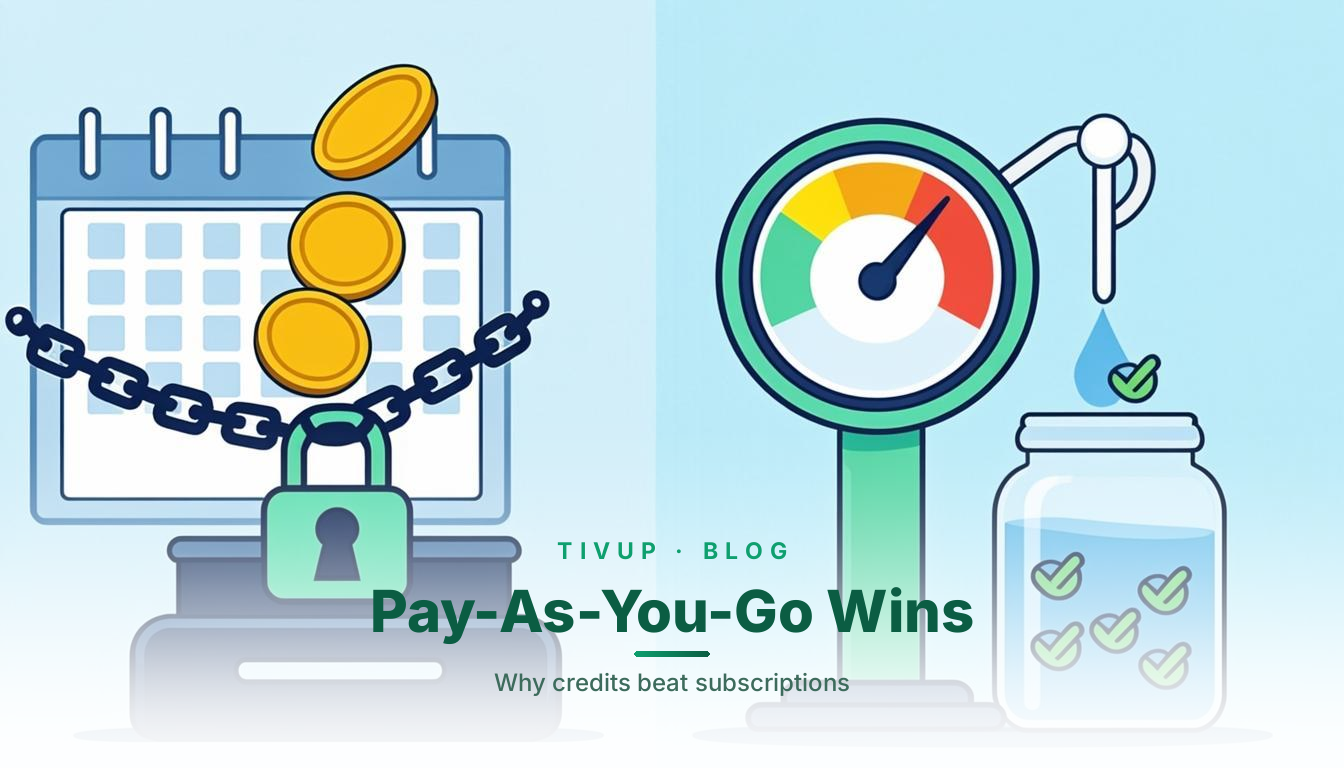

There is a moment every sales manager recognizes: the quiet month. The campaign is paused, the team is busy closing the deals already in play, nothing new is running — and yet the subscription invoice arrives on schedule, exactly the same size as last month. Nobody used the platform. Everybody paid for it.
Pricing feels like a technical detail, but it quietly decides how a tool treats you in the months you need it least — and whether it rewards the months you need it most. Lead generation is bursty work: a campaign this month, a trade-show follow-up next quarter, an expansion push when a new market opens. Flat subscriptions and bursty work are a structural mismatch, not bad luck.
This article compares the two models honestly: the quiet costs of subscriptions, how a credit-based, pay-as-you-go model works in practice, what a real run costs in TivUp credits — with the full math — and the six questions to ask any vendor, including us, before you commit to either model.
The subscription trap: you pay for access, not for work
The mechanic at the heart of subscription software is simple: you rent access. Whether you use that access a little or a lot, the meter runs at a fixed rate. For a tool your team opens every morning, that is a reasonable trade. For a lead-generation engine you fire in bursts, three quiet costs pile up while nobody is looking:
- The dry month. The invoice arrives whether or not anything ran. Over a year, quiet months — holidays, fiscal-year ends, reorganizations, plain slow seasons — can add up to a meaningful share of what you paid, in exchange for nothing at all.
- The expiring allowance. Many plans bundle credits, seats, or usage quotas that reset — or quietly vanish — at the end of each billing cycle. A benefit you lose for not consuming fast enough is not a benefit; it is a deadline. It also trains a bad habit: running mediocre campaigns in the last week of the month just to keep the credits from dying.
- The feature gate. The plan you can afford locks the capabilities you actually need behind the tier above it, and the tier above is priced accordingly. Upgrading is one click; downgrading later is a negotiation.
None of this is a conspiracy — access-based pricing is simply built that way. But notice what the three costs share: in every one of them, you are paying for the possibility of work, not for work done.
Subscription vs pay-as-you-go: the honest comparison
Here is the side-by-side, without flattering either model:
| Dimension | Subscription model | Pay-as-you-go credit model |
|---|---|---|
| What you pay for | Access to the platform, used or not | Work actually done: calls made, leads stored, messages sent |
| Dry months | Full invoice arrives anyway | No runs, no charges — your credits simply wait |
| Scaling up | Tier upgrades, new contracts, prorated invoices | Buy more credits when the campaign grows |
| Scaling down | Downgrade friction; annual terms hold you in place | Run less; there is nothing to cancel |
| Expiry | Usage allowances often reset or expire each cycle | Credits never expire |
| Predictability | Predictable invoice; unpredictable value | Exact cost visible before every run |
| Commitment | Monthly or annual lock-in | None beyond the credits you chose to buy |
The honest part: subscriptions do win on one axis. A flat invoice is easy for a finance team to budget, and in some organizations that alone justifies the model. But predictability of invoice is not predictability of value. A pricing model that shows you the exact cost of a run before you press start gives you the second kind — and the second kind is the one that survives a budget review.
How the credit model works: you buy work, not access
TivUp Pro, the agentic lead-generation platform at tivup.pro, prices everything in a single unit: the credit. The philosophy is pay-per-success — you pay for work done, not for access. Every action in the pipeline carries a published tariff, and every tool call is charged only when it succeeds:
| Operation | Credit cost |
|---|---|
| Smart-brain call (query planning) | 1 credit per call |
| Discovery tool call | 1–3 credits, depending on the tool |
| Each stored lead | 1 credit |
| Lead enrichment | 2 credits per lead |
| Email verification | 1 credit per verification |
| Campaign messages — per message | |
| 1 credit | |
| Telegram | 1 credit |
| SMS | 2 credits |
| 2 credits | |
| Additional regional messengers | 2–5 credits |
Two details turn that table from a price list into a promise. First, if credits run short mid-run, the pipeline stops with a clear error and leaves the decision to you — never a hidden charge. Second, sign-up comes with 10 free welcome credits, no card required, which is enough to watch your first leads appear before you have spent anything.
And if you are curious what would lead a company to this model at all: TivUp delivered lead generation as a manual service for years before rebuilding itself as an agentic platform, and the transitional page tells that story in two minutes.
The credit math: what a run actually costs
Tariffs become real the moment you size an actual run. The canonical example below is a run targeting 25 leads — first as a raw discovery run, then carried through to the enriched, verified list a sales team can actually contact:
| Stage of the run | Approximate credits |
|---|---|
| Smart brain turns your brief into precise search queries | 1 credit per call |
| Parallel discovery across multiple tools | 1–3 credits per tool call |
| Storing the 25 discovered leads | 25 credits |
| Raw run total (before enrichment) | ≈ 31–35 credits |
| Enrichment for all 25 leads | 50 credits |
| Email verification for all 25 leads | 25 credits |
| Full enriched run total | ≈ 106–110 credits |
Read the two totals as unit economics: a raw discovery run over 25 leads lands at roughly 31–35 credits; the same run carried through enrichment and verification lands at roughly 106–110. Spread across the finished list, a complete lead — discovered, deduplicated, enriched with contact data, and verified — costs about 4 credits. That is where the platform’s rule of thumb comes from: 100 credits ≈ 25 complete leads.
Because credits never expire, the leftovers of this month’s run are simply the head start of next quarter’s campaign. Nothing resets on the first of the month. Nothing dies during a slow season.
The price you see is the price you pay
The deeper difference between the two models is not the tariff table — it is when you learn the number. Before every run, the panel lays out the full credit math: the fixed smart-brain calls, the estimated per-tool calls, the per-lead storage and enrichment, the total — and the balance you will have left afterwards. You approve a number, not a hope.
After the run, Pipeline Lab — the platform’s transparency view — shows exactly what every credit did: every tool call, every stored lead, every enrichment, every verification. Between the estimate before and the ledger after, both classic pricing surprises disappear: paying for nothing (the dry month), and paying for you-don’t-know-what (the opaque usage line).
Choosing a pack: scale without lock-in
Credits come in packs sized to how you actually work — and because they never expire, choosing a bigger pack is a discount decision, never a deadline decision:
| Pack | Credits | A sensible fit |
|---|---|---|
| Starter | 100 | A first complete campaign — roughly 25 complete leads, end to end |
| Professional | 500 | A quarterly rhythm of runs, enrichment, and follow-ups |
| Business | 1,000 | An ongoing program across segments and channels |
| Enterprise | 5,000 | Agencies and multi-team usage |
Pack prices are deliberately not quoted here: they live, always current, on the pricing page, and every first purchase of a pack comes with bonus credits. The shape of the offer is the point — you buy what you will run, not what you might someday access.
Before you commit to any pricing model: a checklist
Whether you end up choosing a subscription or credits, run any vendor — including us — through these six questions. One sentence per answer, or walk away:
- ✓ What exactly am I charged in a month when I run nothing?
- ✓ Do credits or usage allowances expire — and on what date?
- ✓ Is the full cost of a run visible before I press start?
- ✓ Can I scale down as easily as I scale up?
- ✓ Am I paying for access, or for work done?
- ✓ What happens, in credits, when a tool call fails?
Pin this checklist next to the pricing page you are comparing. A vendor who cannot answer the first question in one sentence has already answered it.
Conclusion: pay for work, not for seats
Subscription pricing made sense when software was a room your team entered every working day. Lead generation is not that room. It is a campaign engine you fire in bursts — and the fair way to price bursty work is to charge for the work itself: credits bought as needed, tariffs published per action, an exact cost approved before every run, a transparent ledger after it, and leftovers that never expire.
That is the whole philosophy, and it fits in one line: you pay for work done, not for access. The 10 welcome credits are enough to test the claim on a first small run through the Quick Process — before any invoice could exist.
See the exact cost before your first run
Create a free account, fill in the Quick Process form once, and watch the full credit math appear before you press start — 10 welcome credits included, no card required, and nothing expiring while you think it over.